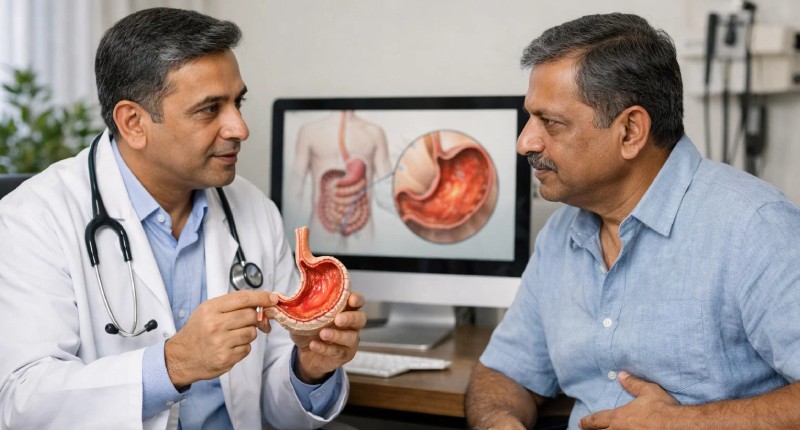
What are Gastric Ulcers?
Gastric ulcers are open sores that develop on the inner lining of the stomach. They can cause abdominal pain, bleeding, and other complications if left untreated.
Why they happen:
Usually caused by Helicobacter pylori (H. pylori) infection or long-term use of nonsteroidal anti-inflammatory drugs (NSAIDs).
How they affect you:
Can cause abdominal pain, bloating, nausea, vomiting, and bleeding.
Prevalence:
Common in people over 50, especially with a history of NSAID use or H. pylori infection.
Symptoms to Watch For
Common:
- Abdominal pain or burning sensation
- Bloating and gas
- Nausea and vomiting
- Loss of appetite
- Indigestion
- Heartburn
Other signs:
- Blood in stool or vomit
- Unexplained weight loss
- Fatigue
- Anemia
Red flags (see a doctor immediately):
- Severe abdominal pain
- Blood in stool or vomit
- Vomiting blood
- Difficulty swallowing
When to See a Doctor?
Immediate:
- Severe abdominal pain
- Blood in stool or vomit
- Vomiting blood
Schedule:
- Symptoms persist or worsen
- Age 50+ (or earlier with family history)
- Screening recommended (endoscopy)
Causes and Risk Factors
- H. pylori infection
- NSAID use
- Genetics: Family history of gastric ulcers
Lifestyle factors:
- Smoking
- Excessive alcohol consumption
- Stress
Medical conditions:
- Zollinger-Ellison syndrome
- Other chronic illnesses
- Genetics: Family history of gastric ulcers
Prevention
- Screening: Endoscopy for high-risk individuals.
- Diet: Eat a balanced diet, avoid spicy or acidic foods
Lifestyle changes:
- Quit smoking
- Limit alcohol consumption
- Manage stress
- Avoid NSAIDs when possible
Diagnosis
Medical History:
Discuss symptoms, family history, and risk factors with your doctor
Physical Exam:
Check for signs of complications
Tests:
Endoscopy:
Gold standard for diagnosing gastric ulcers. A flexible tube with a camera is inserted through the mouth to visualize the stomach lining.
- Procedure: Usually takes 15-30 minutes, sedation is often used
- Benefits: Accurate diagnosis, biopsy can be taken if needed, and therapeutic interventions can be performed
- Preparation: Patients are usually required to fast for 6-8 hours before the procedure
- Risks: Minimal risks, such as bleeding, perforation, or reaction to sedation
Barium swallow:
X-ray test to visualize the stomach
H. pylori test:
Blood, stool, or breath test to detect infection
Biopsy:
Remove tissue sample for analysis
Treatment Options
1. Medications:
- Proton pump inhibitors (PPIs): Reduce acid production
- H2-receptor antagonists: Reduce acid production
- Antibiotics: Treat H. pylori infection
- Antacids: Neutralize stomach acid
2. Endoscopic Treatment:
- Endoscopic clipping: Close bleeding ulcers
- Endoscopic cauterization: Burn bleeding ulcers
- Endoscopic injection: Inject medications to stop bleeding
- Endoscopic stent placement: Open blocked areas
3. Lifestyle changes:
- Quit smoking
- Limit alcohol consumption
- Manage stress
- Avoid NSAIDs when possible
4. Surgery:
Rarely needed, but may be required for complications or persistent symptoms
Why Choose Us?
- Expertise: Our team of gastroenterologists and surgeons have extensive experience in treating gastric ulcers, with a proven track record of successful outcomes.
- Advanced Technology: We use high-definition endoscopes and other cutting-edge equipment to ensure accurate diagnosis and effective treatment.
- Personalized Care: We take the time to understand each patient's unique needs and develop a customized treatment plan to address their specific condition.
- Comprehensive Services: We offer a range of services, including screening, diagnosis, treatment, and follow-up care, all under one roof.
- Minimally Invasive Options: We offer minimally invasive procedures, such as endoscopic treatment, to reduce recovery time and minimize discomfort.
- Multidisciplinary Approach: Our team works closely with other specialists, such as oncologists and surgeons, to provide comprehensive care for patients with complex conditions.
Myths vs Facts
Myth: Gastric ulcers are caused by stress.
Fact: H. pylori infection and NSAID use are the most common causes of gastric ulcers.
Myth: Gastric ulcers can be cured with antacids alone.
Fact: Antacids may provide temporary relief, but treatment usually requires PPIs, antibiotics, or other medications.
Myth: Gastric ulcers are a normal part of aging.
Fact: Gastric ulcers are not a normal part of aging and should be evaluated by a doctor.
Myth: I don't need to worry about gastric ulcers if I don't have symptoms.
Fact: Some people with gastric ulcers may not have symptoms, so screening is important for high-risk individuals.
Myth: Gastric ulcers can be treated with surgery alone.
Myth: Gastric ulcer is the same as gastric cancer.
Fact: Gastric ulcers are benign, while gastric cancer is a malignant tumor. However, chronic H. pylori infection can increase the risk of gastric cancer.
Myth: Endoscopy is a painful and scary procedure.
Fact: Endoscopy is usually a comfortable and safe procedure, and sedation is often used to help patients relax.
Myth: Gastric ulcers will heal on their own without treatment.
Fact: Gastric ulcers often require medical treatment to heal and prevent complications.