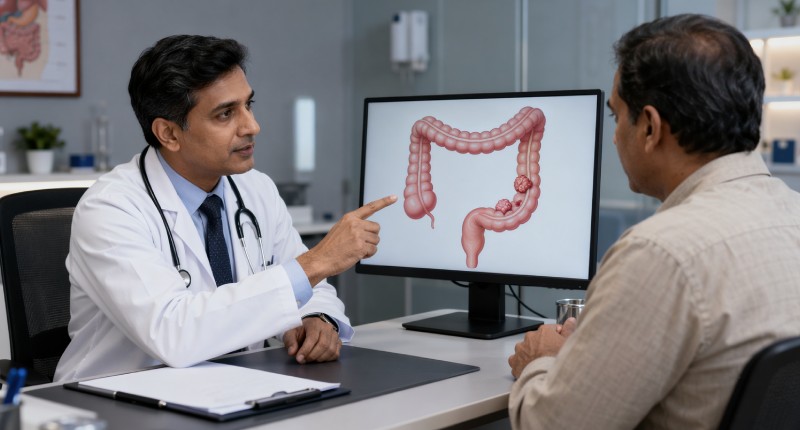
What are Colonic Polyps?
Colonic polyps are growths that occur on the inner lining of the colon or rectum. They can be tiny, like a pea, or large, like a golf ball. Polyps can be flat or raised, and they can occur singly or in groups. They can be benign (non-cancerous) or malignant (cancerous).
Types of Colonic Polyps
Adenomatous Polyps
- Tubular Adenoma: Small, low-risk
- Villous Adenoma: Larger, higher risk
- Tubulovillous Adenoma: Mix of tubular and villous features
Serrated Polyps
- Sessile Serrated Adenoma: Flat, higher risk
- Traditional Serrated Adenoma: Raised, lower risk
- Hyperplastic Polyp: Small, rare risk
Inflammatory Polyps
- Inflammatory Fibroid Polyp: Rare, non-cancerous (IBD)
- Inflammatory Polyp: Non-cancerous (IBD)
Other Types
- Lipoma: Rare, non-cancerous fatty tumor
- GIST: Rare, non-cancerous tumor (surgery)
- Carcinoid Tumor: Rare, slow-growing tumor (surgery)
Cancerous Polyps
- Adenocarcinoma: Colon cancer (surgery, chemotherapy)
- Metastatic Polyp: Cancer spread from other body part
Why they happen
Abnormal cell growth, often linked to genetics, age, or lifestyle factors.
How they affect you
Usually asymptomatic, but can cause bleeding, changes in bowel habits, or abdominal pain.
Prevalence
Common in people over 50, especially with a family history.
Symptoms to Watch For
Common:
- Rectal bleeding
- Changes in bowel movements (diarrhea, constipation)
- Abdominal pain or cramps
Other signs:
- Fatigue, weakness (due to blood loss)
- Unexplained weight loss
Red flags (see a doctor immediately):
- Blood in stool or black, tarry stools
- Severe abdominal pain
- Unexplained weight loss
When to See a Doctor?
Immediate:
- Severe abdominal pain
- Blood in stool
- Vomiting
Schedule:
- Age 45+ (or earlier with family history)
- Symptoms persist or worsen
- Screening recommended (colonoscopy)
Causes and Risk Factors
Genetics
- Family history of colon cancer or polyps
Age
- Increased risk with age, especially over 50
Lifestyle factors:
- Diet: High fat, low fiber
- Smoking
- Obesity
- Lack of exercise
Medical conditions:
- Inflammatory bowel disease (IBD)
- Diabetes
- Acaciation with certain genetic syndromes (e.g., Lynch syndrome)
Prevention
- Screening: Regular colonoscopies (every 10 years, or as recommended)
- Diet: High-fiber, low-fat diet (fruits, veggies, whole grains)
Lifestyle changes:
- Exercise regularly
- Maintain a healthy weight
- Quit smoking
- Limit alcohol consumption
Diagnosis
Medical History:
- Medical History: Discuss symptoms, family history, and risk factors with your doctor
- Physical Exam: Check for signs of complications
Tests:
- Colonoscopy: Gold standard for detecting and removing polyps
- Sigmoidoscopy: Examines lower colon
- CT Colonography: Virtual colonoscopy
- Biopsy: Remove polyp for analysis
- Blood tests: Check for anemia or tumor markers (e.g., CEA)
- Stool tests: FIT (Fecal Immunochemical Test) or C stool DNA
Treatment Options
1. Endoscopic Procedures
- Polyp Removal (Polypectomy): Remove polyps during colonoscopy
- Endoscopic Mucosal Resection (EMR): Specialized technique for larger polyps, involves injecting a solution to lift the polyp and then removing it
- Endoscopic Submucosal Dissection (ESD): Advanced technique for removing larger or complex polyps, involves dissecting the submucosal layer to remove the polyp
- Argon Plasma Coagulation (APC): Thermal ablation for treating bleeding or small polyps
- Endoscopic Band Ligation (EBL): Treats bleeding polyps or lesions
- Cold Snare Polypectomy (CSP): Removes small polyps without electrocautery
Advantages:
- Non-invasive: No external cuts or incisions
- Minimally invasive: Reduced risk of complications and scarring
- Quick recovery: Most patients can return to normal activities within a day
- High success rate: Effective in removing polyps and preventing cancer
- Reduced risk of complications: Lower risk of bleeding, perforation, and infection compared to surgery
2. Surgery
Rarely needed, but may be required for large or cancerous polyps
3. Follow-up Surveillance
Regular colonoscopies to monitor for recurrence or new polyps
Endoscopic resections, such as EMR and ESD, offer several benefits, including:
- Preservation of healthy tissue: Removes only the affected tissue, preserving the surrounding healthy tissue
- Reduced risk of cancer: Removes polyps that may become cancerous, reducing the risk of colon cancer
- Minimally invasive: Reduced risk of complications and scarring compared to surgery
Why Choose Us?
- Expertise: Our team of gastroenterologists and surgeons have extensive experience in performing endoscopic procedures
- State-of-the-art technology: We use advanced equipment and techniques to ensure accurate diagnosis and effective treatment
- Personalized care: We provide individualized care and attention to each patient, ensuring their comfort and well-being
- Comprehensive services: We offer a range of services, including screening, diagnosis, treatment, and follow-up care
Myths vs Facts
Myth: Colonoscopy is a painful and uncomfortable procedure.
Fact: Most patients report minimal discomfort, and sedation is often used to help relax.
Myth: Colonic polyps are always cancerous.
Fact: Most polyps are benign, but some can become cancerous if left untreated.
Myth: I don't need a colonoscopy if I don't have symptoms.
Fact: Many people with colonic polyps don’t have symptoms, so screening is important for early detection and prevention.
Myth: Colonoscopy is only for people with a family history of colon cancer.
Fact: Anyone over 45 years old should get screened, regardless of family history.
Myth: Colonic polyps can't be treated.
Fact: Most polyps can be removed during colonoscopy, and treatment can prevent colon cancer.
Myth: Colonoscopy is a risky procedure.
Fact: Risks are rare, and colonoscopy is a safe and effective screening tool.
Myth: I only need a colonoscopy once.
Fact: Screening recommendations vary, but most people need a colonoscopy every 10 years, or more often if polyps are found.
Myth: Colonic polyps are caused by stress.
Fact: Colonic polyps are caused by abnormal cell growth, often linked to genetics, age, and lifestyle factors.
Myth: I can treat colonic polyps with diet and exercise alone.
Fact: While a healthy diet and lifestyle can help prevent polyps, treatment usually requires removal during colonoscopy.
Myth: Colonoscopy requires a long hospital stay.
Fact: Colonoscopy is usually an outpatient procedure, and most people can go home the same day.